
If you want to sell on Amazon from Texas, opening the Seller Central account is the quick part. The part that catches Texas sellers off guard is the state side: Amazon collects sales tax on your marketplace orders, yet a Texas-based seller still needs a Texas sales tax permit and still files returns. Add the franchise tax report, a pending change to how Texas taxes marketplace fees, and the choice between FBA and shipping orders yourself, and there is a lot to get right. This guide covers the Texas rules that apply specifically to Amazon sellers and the Amazon setup steps, in the order you need them.
Quick Answer
To sell on Amazon from Texas: decide on a business structure (a Texas LLC costs $300 to form with Form 205), get a free EIN from the IRS, apply for a free Texas sales and use tax permit, then register on Seller Central with a government ID, a recent bank or card statement, a bank account and a credit card. Choose the Individual plan ($0.99 per item sold) or Professional ($39.99 a month), plus referral fees that are 15% in many categories. Amazon collects and remits Texas sales tax on your Amazon orders, but you still file your Texas sales tax returns, report those sales as non-taxable marketplace sales, and file your annual franchise tax information report if you have an LLC.
In this guide
- Set up your Texas business
- Texas sales tax rules for Amazon sellers
- Open and set up your Amazon seller account
- FBA or FBM from Texas
- Costs to sell on Amazon from Texas
- Worked example: one month of Amazon sales
- Common mistakes
- Tips for Texas Amazon sellers
- FAQ
Step 1: Set Up Your Texas Business
Amazon lets you register as an individual or as a business, so an LLC is not required to start. Many Texas sellers still form one before they scale, because it separates business liabilities from personal assets when it is run properly and keeps your Amazon payouts, bank account and tax records under one business name.
Form a Texas LLC (optional but common)
A Texas LLC is created by filing Form 205, the Certificate of Formation, with the Texas Secretary of State. The filing fee is $300. You can file online through SOSPortal (ACH, or a credit card with a convenience fee of $0.25 plus 2.25%) or by mail with a check or money order. You need a Texas registered agent at a street address, at least one manager or member, and an initial mailing address, which is where the Comptroller sends your tax correspondence. The form does not need to be notarized.
We cover LLC naming, assumed names and the sole proprietor route in more detail in our guide to starting a Shopify store in Texas. The formation steps are the same whichever channel you sell on.
Get an EIN
An Employer Identification Number is free when you apply directly with the IRS, and the online application issues it immediately once approved. Use it for your business bank account, your Texas permit application and Amazon’s tax information step. Ignore third-party sites that charge for it.
Plan for the Texas franchise tax report
Texas LLCs and corporations are subject to franchise tax. For 2026 and 2027 reports, an entity with annualized total revenue at or below $2,650,000 owes no tax, but it still files a Public Information Report or Ownership Information Report each year. Reports are due May 15. The Comptroller’s 2026 franchise tax instructions explain which forms apply.
Step 2: Texas Sales Tax Rules for Amazon Sellers
What Amazon does
Texas treats Amazon as a marketplace provider. Marketplace providers engaged in business in Texas must collect, report and remit state and local sales and use tax on all sales made through their marketplace, and they must certify to sellers that they are doing so. Once Amazon has certified it, you are not responsible for collecting tax on your Amazon orders. Keep a copy of that certification with your records. If a marketplace has not issued one, the Comptroller says the seller should collect tax until it does.
What you still do as a Texas-based seller
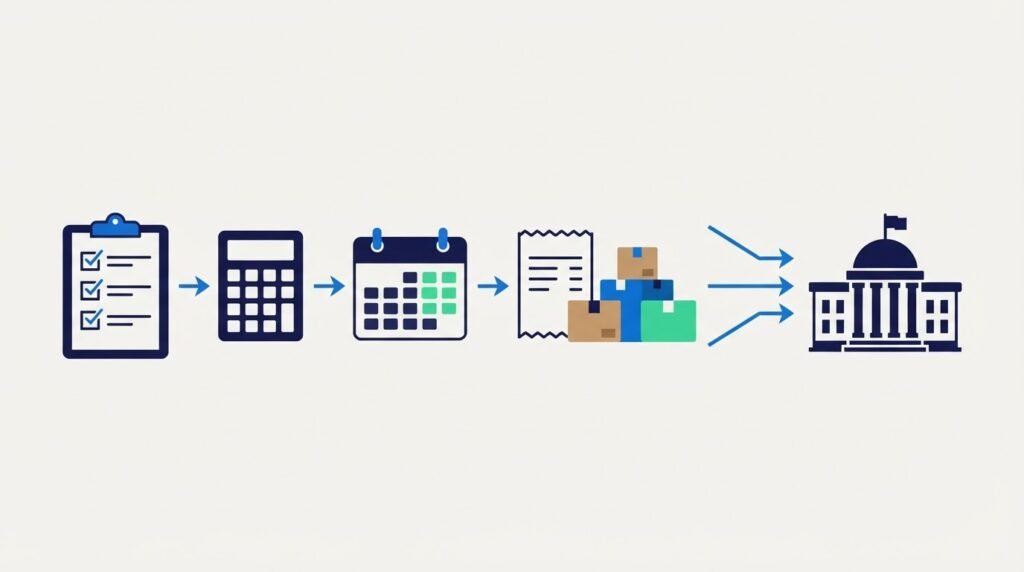
The Comptroller’s marketplace seller page is direct about this: if you are a Texas seller selling through a marketplace, you still need a Texas sales tax permit and must file your returns on time, even if every sale goes through a marketplace provider. In practice that means:
- Get the permit. Apply online or with Form AP-201. The permit itself is free.
- File on your assigned schedule. After approval, the Comptroller tells you by letter how often you file. Quarterly returns are due April 20, July 20, October 20 and January 20.
- Report marketplace sales correctly. Your Amazon sales go into Total Texas Sales on the return, but they are excluded from Taxable Sales when Amazon has certified that it collects the tax. That is how you avoid paying the tax twice.
- Keep records for four years. Hold on to Amazon’s tax reports, settlement reports and the certification.
If you also sell outside Amazon, such as at markets, on your own website or wholesale, you collect Texas tax on those sales yourself. Texas charges a 6.25% state rate and local jurisdictions can add up to 2%, for a maximum combined rate of 8.25%.
The tax on marketplace fees is changing
Separate from the tax your customers pay, Texas amended its data processing rule (Rule 3.330) in 2025 so that certain fees marketplaces charge sellers could be taxed as data processing services. On September 30, 2026, Comptroller Don Huffines announced an executive order directing the agency to propose removing marketplace and platform fees, including fees paid by sellers on Amazon, from that definition. The proposal goes through publication in the Texas Register and a 30-day comment period before it can take effect, and the current rule applies until then. Check the Comptroller’s site for whether the amended rule has been adopted before you budget for or claim anything related to tax on your Amazon fees.
If your business is outside Texas but your FBA inventory is here
Amazon may store your inventory in Texas fulfillment centers even if your business is based elsewhere. The Comptroller’s remote seller guidance says a remote seller under the $500,000 safe harbor, selling only through a marketplace that has certified it collects tax, does not need a Texas permit. A remote seller above $500,000 with inventory stored in Texas must get a permit and collect on its own sales. Separately, a taxable entity with inventory temporarily stored in a marketplace provider’s Texas facility has franchise tax responsibility.
Step 3: Open and Set Up Your Amazon Seller Account
1. Gather your documents
Amazon’s seller registration guide asks for a government-issued ID, proof of your business address dated within the last 180 days (such as a bank or credit card statement), a bank account for payouts, a credit card for fees, and your tax information. The card does not have to be in your name or your business’s name. Make sure names and addresses match across every document you upload.
2. Choose a selling plan
According to Amazon’s pricing page, the Individual plan costs $0.99 per item sold and the Professional plan costs $39.99 a month. Professional adds bulk listing tools, Amazon Ads, Automate Pricing, brand tools through Brand Registry, Amazon Business and API access. If you expect to sell more than about 40 items a month or plan to advertise, Professional usually makes more sense. You can switch or cancel your plan after registration.
3. Complete verification and the tax interview
Register as the business if you formed an LLC, using the LLC’s legal name and EIN so Amazon’s tax reporting matches your Texas filings. Then finish identity verification.
4. Check category requirements and list products
Some categories and products require approval before you can list them, so check before you buy inventory. Then create or match listings, set prices, and confirm the referral fee category, because Amazon notes that a product’s fee category may differ from the category customers see in the store.
If you would like help with registration, listings or the Texas compliance calendar, you can book a consultation with Msharf and plan your Amazon launch with our team.
FBA or FBM: Which Works Better from Texas?
Both plans can use Fulfillment by Amazon (FBA), where Amazon stores, ships and handles returns, or Fulfilled by Merchant (FBM), where you ship orders yourself.
- FBA suits small, fast-moving products and sellers who want Prime eligibility without running a warehouse. You pay per-unit fulfillment and storage fees, which you should estimate in Amazon’s Revenue Calculator before you send inventory.
- FBM suits bulky, slow-moving or made-to-order items, and sellers who already have space and shipping accounts. Texas is a large state, so if you ship from your own location, set realistic handling and transit times for both Texas and out-of-state customers.
Your Texas sales tax treatment is the same either way: Amazon collects tax on marketplace orders, and you report them as described above.
Costs to Sell on Amazon from Texas
| Item | Cost | Notes |
|---|---|---|
| Texas LLC Certificate of Formation (Form 205) | $300 | Optional; one-time state fee |
| EIN from the IRS | $0 | Apply directly with the IRS |
| Texas sales and use tax permit | $0 | Required for Texas-based sellers, even Amazon-only |
| Franchise tax (revenue ≤ $2,650,000) | $0 tax | Information report still due May 15 for LLCs |
| Amazon Individual plan | $0.99 per item sold | No monthly fee |
| Amazon Professional plan | $39.99/month | No per-item plan fee |
| Referral fees | Varies by category | 15% in many categories (e.g. Home and Kitchen, Toys and Games); usually a $0.30 minimum |
| Media closing fee | $1.80 per item | Books, music, DVD, software, video |
| FBA fulfillment and storage | Varies | Based on size, weight and storage time |
Worked Example: One Month of Amazon Sales from Texas
These numbers are illustrative only, not real results or a forecast. Imagine a Texas LLC on the Professional plan selling a $25 kitchen item that it ships itself (FBM). In one month it sells 300 units on Amazon, $7,500 in sales, and 110 of those units ($2,750) ship to Texas addresses.
- Plan fee: $39.99. On the Individual plan, 300 × $0.99 would be $297.
- Referral fees: Home and Kitchen is 15%, so $25 × 15% = $3.75 per unit, or $1,125 for the month. Amazon calculates the fee on the total price, so any shipping you charge raises it.
- Texas sales tax: Amazon collects tax on the 110 Texas orders. On the seller’s Texas return, the $2,750 goes into Total Texas Sales and is excluded from Taxable Sales, so the seller owes no sales tax on those orders.
- Out-of-state orders: tax on the other 190 units falls under each destination state’s marketplace rules.
The point is that an Amazon-only Texas seller can owe $0 in sales tax for a period and still has to file the return.
Common Mistakes Texas Amazon Sellers Make
- Skipping the Texas permit because Amazon collects tax. That exemption is for out-of-state remote sellers, not sellers located in Texas.
- Reporting Amazon sales as taxable. Put them in Total Texas Sales but not Taxable Sales, or you may pay tax Amazon already remitted.
- Missing zero returns. A permit means a return every period, even when you owe nothing.
- Forgetting the franchise report. Owing no franchise tax still means filing an information report by May 15.
- Registering on Amazon under one name and with the state under another. Keep the LLC, EIN, bank account and seller account aligned.
- Pricing without the referral fee. At 15%, the referral fee is often your largest per-sale cost.
Tips for Texas Amazon Sellers
- Download Amazon’s tax reports every filing period so your Total Texas Sales figure comes from a record you can show if audited.
- Watch the marketplace fee rule. If the Rule 3.330 amendment is adopted, ask your tax adviser how it affects your fee invoices.
- Run the Revenue Calculator before every new product, comparing FBA and FBM costs.
- Plan your second channel. Walmart Marketplace is also a marketplace provider in Texas; see our Walmart Marketplace seller guide. A Shopify store is different, because you collect that tax yourself.
- Get help where it saves time. Our team handles Amazon, Walmart and Shopify store management, plus website, SEO and marketing for brands that want traffic beyond Amazon.
FAQ
Do I need a Texas sales tax permit if I only sell on Amazon?
Yes, if you are a Texas seller. The Comptroller requires Texas sellers to hold a permit and file returns even when all sales go through a marketplace provider. Out-of-state sellers below $500,000 in Texas sales who only sell through a certified marketplace generally do not need one.
Does Amazon collect Texas sales tax for me?
Yes, on orders placed through Amazon once it has certified that it collects on your behalf. Sales you make anywhere else are your responsibility.
Do I need an LLC to sell on Amazon in Texas?
No. You can register as an individual. An LLC costs $300 to form and adds an annual franchise tax information report, in exchange for liability separation.
How much does it cost to start selling on Amazon from Texas?
The state permit and EIN are free. Amazon charges $0.99 per item on Individual or $39.99 a month on Professional, plus referral fees, and FBA fees if you use it. Forming an LLC adds $300.
How do I report Amazon sales on my Texas sales tax return?
Include them in Total Texas Sales and exclude them from Taxable Sales, as long as Amazon has certified that it collects the tax.
Are Amazon seller fees taxed in Texas?
Under the 2025 version of Rule 3.330, certain marketplace fees can be treated as taxable data processing. The Comptroller announced on September 30, 2026 that the agency would propose removing them. Check the current status with the Comptroller or a tax professional.
Final Thoughts
Selling on Amazon from Texas is straightforward once you separate what Amazon handles from what stays with you. Amazon collects the sales tax on your orders. You hold the Texas permit, file every return with marketplace sales reported correctly, file the franchise information report if you have an LLC, and keep an eye on the marketplace fee rule. For more seller guides, visit the Msharf blog.
Looking to build or scale your Amazon, Walmart, or Shopify business? Msharf can help you develop and manage your e-commerce business. Book a consultation with our team.
Information in this guide is based on official sources from the Texas Secretary of State, the Texas Comptroller of Public Accounts, the IRS and Amazon as of November 2026, and can change. It is general information, not legal or tax advice.