
Opening a Shopify store in Florida is one of the fastest ways to sell your own products online, but the state paperwork is where many new sellers get stuck. Florida has no single “online seller license.” Instead, you deal with Sunbiz for your business entity, the Florida Department of Revenue for sales tax, and your county or city for a local business tax receipt. Each has its own deadlines and fees.
This beginner-friendly guide covers each step in order, with current official fees, a cost table, an illustrative example and the mistakes that cost Florida sellers money.
Quick Answer
To start a Shopify store in Florida: (1) form an LLC on Sunbiz for $125 ($100 filing fee plus a $25 registered agent designation), or operate as a sole proprietor and register a fictitious name for $50 if you use a brand name; (2) get a free EIN from the IRS; (3) register with the Florida Department of Revenue as a sales and use tax dealer before you start selling taxable goods; (4) get a local business tax receipt from your county and, if you are inside city limits, your city; (5) pick a Shopify plan (Basic is $39/month, or $29/month billed yearly), add your Florida tax registration in Shopify and collect 6% state tax plus the county surtax for the delivery address. Then file your LLC annual report every year between January 1 and May 1 to avoid a $400 late fee.
In this guide
- Why Florida is different for Shopify sellers
- Step 1: Form your business on Sunbiz
- Florida sales tax for Shopify stores
- How to set up your Shopify store step by step
- What it costs to launch in Florida
- Worked example: a first month in numbers
- Common mistakes Florida sellers make
- Tips to grow a Florida Shopify store
- FAQ
- Conclusion
Why Florida is different for Shopify sellers
Three things set Florida apart from a generic Shopify checklist:
- County surtax follows the customer. On top of the 6% state rate, many counties add a surtax based on where the item is delivered, so one store can charge several combined rates.
- The annual report deadline is strict. Every LLC files between January 1 and May 1; after that a $400 late fee applies that cannot be waived.
- Home businesses need local receipts too. Counties and cities levy a local business tax under Chapter 205 of the Florida Statutes, and many include one-person, home-based businesses.
If you have read our guides on starting a Shopify store in Texas or selling on Shopify in California, you will notice Florida sits in the middle: far cheaper to keep an LLC active than California, but with more local tax detail than many sellers expect.
Step 1: Form your business on Sunbiz
Florida’s Division of Corporations runs its online filing system, Sunbiz. Most Shopify sellers choose a single-member LLC because it separates business and personal liability and is simple to maintain. According to the Sunbiz instructions for Florida LLC Articles of Organization, the fees for a new LLC are:
- Articles of Organization: $100
- Registered agent designation: $25 (required)
- Certified copy of your Articles: $30 (optional)
- Certificate of status: $5 (optional)
Your registered agent must have a physical street address in Florida (not a P.O. box), and the LLC cannot be its own agent, although you personally can serve. Keep in mind that address becomes part of the public record. The LLC name must include “Limited Liability Company,” “LLC” or “L.L.C.” and must be distinguishable from names already on file, so search Sunbiz before you buy a domain or design a logo.
Timing tip for a fall or winter launch
Sunbiz lets an LLC list an effective date up to 90 days after filing. If you form between October 1 and December 31 but will not do business until the new year, Sunbiz suggests listing January 1 as the effective date, which postpones your first annual report by one calendar year. Only use this if your store truly launches in January.
Using a store name that is not your legal name
If your Shopify brand differs from your legal name (for example, your LLC is “Rivera Home Goods LLC” but your store is “Gulf Breeze Candles”), Florida requires a fictitious name registration on Sunbiz. The fee is $50, the registration lasts five years, and you must advertise the name at least once in a newspaper in the county of your principal place of business. Newspapers set their own price for that notice.
Get your EIN
Apply for an Employer Identification Number directly with the IRS. The IRS states you never have to pay a fee for an EIN. You will use it for your business bank account, Shopify Payments verification and your Florida tax registration.
Florida sales tax for Shopify stores
Register as a dealer before your first sale
The Florida Department of Revenue registration page is direct: if your business will sell taxable goods or services, you must register as a sales and use tax dealer to collect, report and remit sales tax before you begin conducting business in Florida. You can register online through the Florida Business Tax Application, which walks you through which taxes apply, or file the paper Form DR-1. Once approved, you receive a Certificate of Registration and an Annual Resale Certificate, which lets you buy inventory for resale without paying tax to your supplier.
6% state rate plus the county surtax
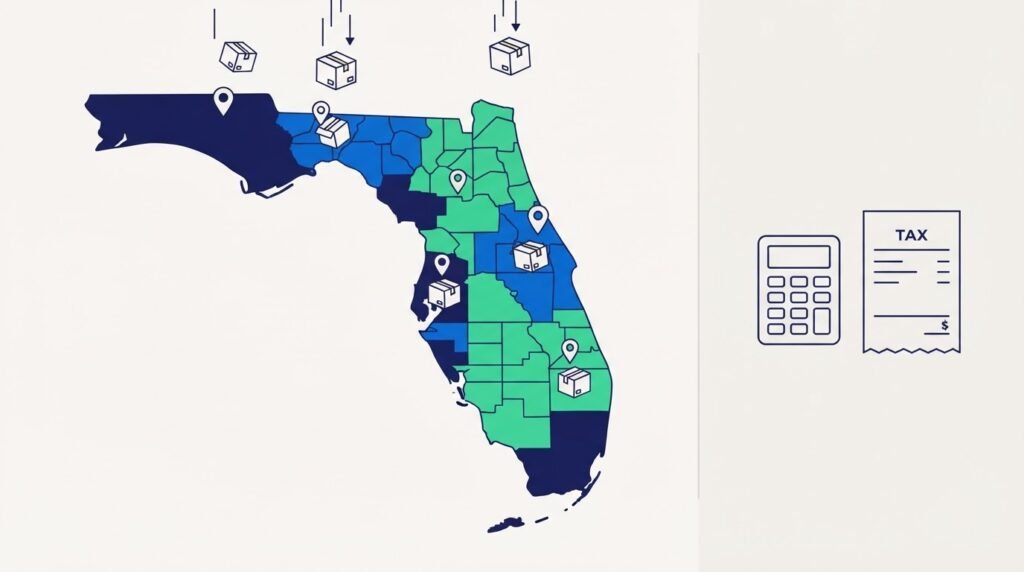
Per the Florida Department of Revenue sales and use tax page, the general state sales tax rate is 6%. Many counties add a discretionary sales surtax, and the county rate applies to a taxable item delivered into a county that imposes one. The department publishes county rates each year on Form DR-15DSS and offers an address lookup tool. For a Shopify store that ships statewide, the rate on each order depends on the customer’s delivery county, not on where you live.
What if you also sell on Amazon or Walmart?
Your Shopify storefront is your own website, so on those orders you are the dealer who collects and remits Florida tax. Marketplaces work differently. Since July 1, 2021, Florida has required marketplace providers with more than $100,000 in taxable remote sales into the state to register and collect tax on the sales they facilitate, and when the marketplace collects the tax you do not collect it again on those orders. Out-of-state sellers measuring the $100,000 remote-sales threshold count only their direct, non-marketplace sales into Florida. If you plan to add a marketplace channel later, our Walmart 2-step dropshipping service explains how those orders can run alongside a Shopify store.
Local business tax receipt
Florida counties and cities may charge a local business tax for the privilege of doing business in their area, under the Local Business Tax Act (Chapter 205, Florida Statutes). Receipts are valid for up to one year and generally expire on September 30. Rates and rules are set locally, so contact your county tax collector, and your city if your address is inside city limits. Some cities also ask for zoning approval or a home-based business form. Check the exact fee locally rather than guessing.
How to set up your Shopify store step by step

Once your LLC, EIN and Florida sales tax registration are in place, the Shopify side is straightforward:
- Choose a plan. Shopify’s pricing page lists Basic at $39/month (or $29/month billed yearly), Grow at $105/month ($79 yearly) and Advanced at $399/month ($299 yearly). Shopify currently advertises a 3-day free trial followed by $1/month for the first three months. Basic is enough for most new Florida stores.
- Enter your business details. Use your LLC’s legal name and Florida address in Settings, and connect a business bank account in the LLC’s name.
- Activate Shopify Payments. On Basic, online standard card rates are 2.9% + 30¢. If you use a third-party payment provider instead, Shopify charges a transaction fee of 2% on Basic (1% on Grow, 0.6% on Advanced).
- Add your Florida tax registration. In your Shopify admin, go to Settings > Taxes and duties > United States, choose Collect sales tax, select Florida and enter your registration number. Shopify then calculates the state rate and county surtax at checkout. Shopify does not register you with the state; you must register first.
- Keep an eye on other states. Shopify’s tax liability report on the Taxes and duties page flags states where your sales may have created nexus, which matters once you ship many orders outside Florida.
- Place a test order to a Florida address in a different county from yours and confirm the tax line shows the state rate plus that county’s surtax.
If you would rather hand off the build, theme customization and launch checklist, our Shopify website design and development service covers new stores, redesigns and ongoing store management.
What it costs to launch in Florida
Here are the main fixed costs for a new Florida Shopify seller, based on the official sources linked in this guide:
| Item | Cost | When |
|---|---|---|
| LLC Articles of Organization (Sunbiz) | $100 | Once, at formation |
| Registered agent designation | $25 | Once, at formation |
| Certified copy / certificate of status (optional) | $30 / $5 | At formation, if wanted |
| LLC annual report | $138.75 | Every year, Jan 1 – May 1 |
| Late annual report fee | $400 | If filed after May 1 |
| Fictitious name registration (if using a brand name) | $50 + newspaper notice | Every 5 years |
| EIN from the IRS | $0 | Once |
| Local business tax receipt | Set by county/city | Yearly, expires Sept 30 |
| Shopify Basic plan | $39/mo monthly or $29/mo yearly | Monthly or yearly |
| Shopify Payments online card rate (Basic) | 2.9% + 30¢ per order | Per transaction |
Not included: inventory, packaging, a domain, paid apps, a premium theme and advertising, which vary widely by product.
Worked example: a first month in numbers
The numbers below are illustrative, not a real seller’s results. Imagine a home-based candle brand formed as a Florida LLC in November 2026. The owner pays $125 to Sunbiz, $50 for a fictitious name plus a newspaper notice, and picks Shopify Basic on monthly billing at $39.
Suppose the first full month brings 100 orders at $40 each, or $4,000 in product sales. With Shopify Payments at 2.9% + 30¢, card processing comes to about $116 + $30 = $146. If one order ships to a county with a 1% surtax, the customer pays 7% tax, or $2.80 on a $40 candle. That $2.80 is not income; it is held for the Florida Department of Revenue and paid with the sales tax return. Because the LLC became effective in 2026, its first $138.75 annual report is due between January 1 and May 1, 2027.
Common mistakes Florida sellers make
- Selling before registering for sales tax. Florida expects you to register before you begin conducting business, not after your first big month.
- Charging one flat rate statewide. A single combined rate ignores the delivery-county surtax. Let Shopify calculate it from your registration instead of a manual override.
- Missing May 1. The $400 late fee applies even if you never received a reminder. Put the January 1 – May 1 window in your calendar now.
- Skipping the fictitious name, or its newspaper notice, when your store brand differs from your LLC name.
- Ignoring the local business tax receipt because the business is home-based.
- Mixing personal and business money. Send Shopify payouts to the LLC’s bank account to protect your liability shield and keep bookkeeping clean.
Tips to grow a Florida Shopify store
- Use your Annual Resale Certificate when buying inventory so you are not paying tax on goods you will resell.
- Offer local pickup or delivery for customers in your own metro area.
- Plan for seasonality. Tourism peaks and hurricane season can shift demand and shipping times, so keep inventory and carrier options flexible.
- Add channels gradually. Once your store converts, marketplaces can extend your reach; our Amazon micro private label service is one route for sellers ready to build a brand there.
Not sure your setup is complete, or want a store built to convert from day one? Book a free 30-minute consultation and we will review your plan with you.
FAQ
Do I need an LLC to sell on Shopify in Florida?
No. You can sell as a sole proprietor, but you still need to register for Florida sales tax and get a local business tax receipt. An LLC costs $125 to form on Sunbiz and helps separate business and personal liability, which is why many sellers choose it.
How much does it cost to register a Florida LLC for a Shopify store?
The Sunbiz fee is $125: $100 for the Articles of Organization and $25 for the registered agent designation. A certified copy ($30) and certificate of status ($5) are optional. After that, the annual report costs $138.75 each year.
What sales tax rate do I charge Florida customers?
The state rate is 6%, plus the discretionary sales surtax of the county where the order is delivered, if that county has one. The Florida Department of Revenue publishes the rates on Form DR-15DSS and through its address lookup tool.
Does Shopify file my Florida sales tax returns?
For most stores, no. Shopify calculates and collects tax at checkout in states where you have added a registration, but you file and pay the returns with the Florida Department of Revenue yourself.
When is the Florida LLC annual report due?
Between January 1 and May 1 every year, starting the year after your LLC’s effective date. Filing after May 1 adds a $400 late fee, and an LLC that never files is administratively dissolved.
Do I need a business license for a home-based online store in Florida?
Florida has no single statewide general business license, but counties and cities can require a local business tax receipt, and many specifically include home-based businesses. Check with your county tax collector and your city.
Conclusion
Starting a Shopify store in Florida comes down to a short, ordered checklist: form your LLC on Sunbiz, get an EIN, register as a sales tax dealer before your first sale, get your local business tax receipt, then connect it all inside Shopify so the 6% state rate and county surtax are charged correctly. Keep the January 1 – May 1 annual report window on your calendar and you will avoid the most expensive mistake Florida sellers make. With the paperwork handled, your time can go where it matters: products, customers and growth.
Looking to build or scale your Amazon, Walmart, or Shopify business? Msharf can help you develop and manage your e-commerce business. Book a consultation with our team.
Information in this guide is based on official sources (Florida Division of Corporations, Florida Department of Revenue, IRS and Shopify) as of November 2026 and can change. Check the linked sources or a tax professional before you file.
2 comments