
Starting Amazon FBA in Florida looks simple from the Seller Central side: register, list, send inventory. The Florida side is where new sellers trip up. Amazon collects Florida sales tax on your marketplace orders, but that does not settle every question about registration, resale certificates or the county property return most online sellers have never heard of. This guide separates what Amazon handles from what stays with you as a Florida seller, then walks through setup, costs and the yearly deadlines in the order you will meet them.
Quick Answer
To start Amazon FBA in Florida: optionally form an LLC on Sunbiz ($125: $100 Articles of Organization plus a $25 registered agent designation), get a free EIN from the IRS, then register on Seller Central with a government ID, a recent bank or card statement, a bank account, a credit card and your tax information. Choose the Individual plan ($0.99 per item sold) or Professional ($39.99 a month), and budget for referral fees (15% in many categories) plus FBA fees. Amazon collects and remits Florida sales tax on orders placed through Amazon, and you leave those sales off your own Florida return. If you also sell outside Amazon, or want to buy inventory tax-free with a Florida Annual Resale Certificate, register with the Florida Department of Revenue. Each year, file your LLC annual report between January 1 and May 1 and, if you own business equipment, a tangible personal property return with your county by April 1.
In this guide
- What Amazon handles vs. what you handle in Florida
- Step 1: Set up your Florida business
- Step 2: Florida sales tax and resale certificates
- Step 3: The county property return most sellers miss
- Step 4: Open Seller Central and set up FBA
- What Amazon FBA costs in Florida
- Worked example: a first inventory order
- Your Florida compliance calendar
- Common mistakes
- Tips for Florida FBA sellers
- FAQ
What Amazon Handles vs. What You Handle in Florida
Amazon does not take care of “taxes” in general. It handles sales tax on orders placed through Amazon. Here is how the rest splits for a Florida-based seller.
| Task | Who handles it |
|---|---|
| Collecting and remitting Florida sales tax and county surtax on Amazon orders | Amazon, as the marketplace provider |
| Forming and maintaining your LLC (annual report) | You, on Sunbiz |
| Sales tax on sales outside Amazon (your website, markets, wholesale) | You, through the Florida Department of Revenue |
| Getting and using an Annual Resale Certificate to buy inventory tax-free | You, as a registered dealer |
| Use tax on inventory you pull for your own use | You |
| Tangible personal property return for business equipment | You, with your county property appraiser |
| Local business tax receipt | You, with your county and city |
Step 1: Set Up Your Florida Business
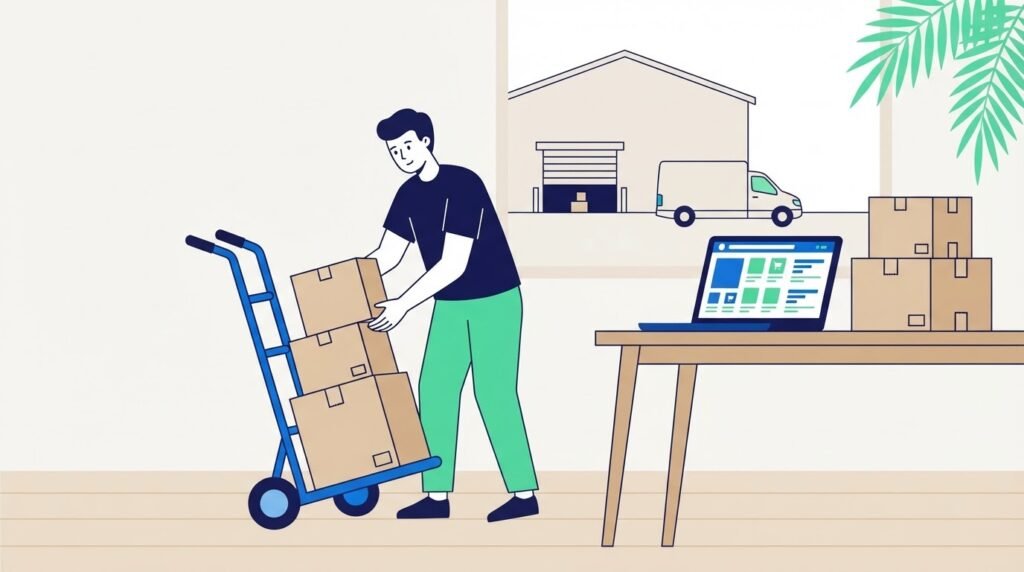
Amazon does not require an LLC. Its registration guide lets you select “None, I am an individual” as your business type. Many Florida sellers still form an LLC before they order serious inventory, because it keeps the business’s debts, bank account and Amazon payouts separate from their personal finances.
Forming an LLC on Sunbiz
According to the Sunbiz instructions for Florida LLC Articles of Organization, a new LLC costs $100 for the Articles plus $25 for the registered agent designation. A certified copy ($30) and certificate of status ($5) are optional. If you form between October 1 and December 31 but will not start selling until the new year, Sunbiz lets you list January 1 as the effective date, which pushes your first annual report back a year.
We cover LLC naming, fictitious names and local business tax receipts in more depth in our guide to starting a Shopify store in Florida. The formation steps are the same whichever channel you sell on.
EIN and state income tax
Get your EIN directly from the IRS; it is free. Florida does not tax individuals’ income, and under Florida law an LLC classified as a partnership for federal income tax purposes is not subject to Florida corporate income tax.
Step 2: Florida Sales Tax and Resale Certificates
Amazon’s role under Florida’s marketplace law
Since July 1, 2021, Florida has required marketplace providers like Amazon to collect and remit Florida sales tax and discretionary sales surtax on taxable sales made through their marketplace, and to certify that to their sellers. When the marketplace has certified it will collect, Florida law says the seller may not collect tax on those orders and must exclude them from its own sales tax return. That prevents the tax from being paid twice.
When a Florida seller still registers
The Florida Department of Revenue’s registration page says a marketplace seller with a physical presence in Florida must register as a dealer and collect tax on its taxable sales made outside the marketplace. As a Florida-based seller, that applies to you as soon as you sell anywhere other than Amazon: your own Shopify site, a local market, a pop-up or wholesale accounts. Registration is done online through the Florida Business Tax Application or on paper with Form DR-1.
If you sell only on Amazon, confirm your status with the Department’s online application wizard or a tax professional. Many Amazon-only sellers register anyway to get a resale certificate.
The Annual Resale Certificate and FBA sourcing
Florida issues an Annual Resale Certificate for Sales Tax (Form DR-13) to registered dealers whose sales tax account is active. You give it to suppliers so you can buy inventory you will resell without paying Florida sales tax at purchase. For FBA sellers who source from Florida wholesalers or distributors, that is real cash flow: without it, you pay 6% state tax plus any county surtax on inventory, and the tax becomes part of your product cost.
Two strings come attached. First, the Department’s sales and use tax page explains that if you buy an item tax-exempt to resell it and then use it in your business or personally, you owe use tax on it. Units you keep for product photos, testing or gifts count. Second, a registered dealer files a return for every reporting period, even when no tax is due, and a late return carries a minimum $50 penalty.
Florida’s state rate is 6%, plus any county surtax for the delivery address. Amazon works that out on its orders; you do on your other sales.
Step 3: The County Property Return Most Sellers Miss
Florida taxes tangible personal property (TPP) used in a business, and it is filed with your county property appraiser, not the state. The Department of Revenue’s TPP questions and answers (PT-114) sets out the key points for Amazon sellers:
- Your inventory is excluded. Inventory held for sale as part of your business is not reported, so the stock in your garage or in Amazon’s warehouses does not go on the return.
- Your equipment is included. Computers, label printers, shelving, scales and other business assets you own on January 1 are reportable, including personally owned property used in the business.
- File Form DR-405 by April 1. Anyone who owns TPP on January 1 files with the county property appraiser by April 1, one return for each site where you do business.
- Filing on time unlocks the $25,000 exemption. A timely return makes you eligible for an exemption of up to $25,000 of assessed value, which covers the equipment of most small sellers.
- Penalties are a percentage of the tax. Not filing costs 25% of the tax levied per year; late filing costs 5% per month, up to 25%; leaving property off costs 15% of the tax on what you omitted.
Some counties waive later returns while assets stay under $25,000, but the first return establishes the exemption.
Step 4: Open Seller Central and Set Up FBA
- Gather documents. Amazon asks for a government-issued ID, a chargeable credit card, a bank account and routing number, your business registration if you have one, proof of address dated within the last 180 days (such as a bank or card statement) and your tax information. The payout bank account must be in your name or your business’s name.
- Register as your LLC if you formed one, using the exact name on your Sunbiz filing and your Florida address, so Amazon’s tax reporting matches your records.
- Pick a plan. Per Amazon’s pricing page, Individual is $0.99 per item sold and Professional is $39.99 a month. You can switch plans after registration.
- Verify your identity. Upload your ID and proof of address, then take a photo or join a video call. Amazon says verification usually takes three business days or less.
- Protect your brand if you have one. Brand Registry is free but needs a pending or registered trademark, and Amazon recommends enrolling before you list.
- Run the Revenue Calculator before you ship. FBA fulfillment and storage fees depend on size, weight and time in storage, so compare FBA and your own fulfillment for each product before you create an inbound shipment.
If you would rather have product research, sourcing and launch handled with you, our Amazon micro private label service starts from $500 and runs on a 70/30 profit share. You can also book a 30-minute consultation to talk through your Florida setup before you buy inventory.
What Amazon FBA Costs in Florida
| Item | Cost | Frequency |
|---|---|---|
| LLC Articles of Organization + registered agent designation | $100 + $25 | Once (optional entity) |
| LLC annual report | $138.75 ($400 late fee after May 1) | Yearly, January 1 to May 1 |
| EIN | $0 | Once |
| Florida sales tax registration | No fee listed by the Department | Once; returns every assigned period |
| TPP return (DR-405) | $0 to file; tax only above the $25,000 exemption | By April 1 |
| Local business tax receipt | Set by your county and city | Yearly |
| Amazon Individual plan | $0.99 per item sold | Per sale |
| Amazon Professional plan | $39.99 | Monthly |
| Referral fees | Varies; 15% in many categories, usually a $0.30 minimum | Per sale |
| FBA fulfillment and storage | Varies by size, weight and storage time | Per unit / monthly |
Worked Example: A First Inventory Order
All numbers below are illustrative, not a real seller’s results or a forecast. The 7% combined rate assumes a county with a 1% surtax.
A Tampa-area LLC on the Professional plan buys 300 kitchen gadgets at $10 each ($3,000) from a Florida distributor, then sends them to FBA.
- With a resale certificate: no sales tax at purchase. Without one, the seller would pay about $210 (7% of $3,000) up front, money that never comes back.
- Use tax on samples: the seller keeps two units for photos. That is $20 of inventory used in the business, so about $1.40 of use tax goes on its next Florida return.
- Sales: 250 units sell at $24.99, or $6,247.50. Home and Kitchen carries a 15% referral fee, about $3.75 per unit or $937.13 in total, plus the $39.99 plan fee and per-unit FBA fees from the Revenue Calculator.
- Florida orders: Amazon collects tax on any that ship to Florida addresses, and the seller leaves them off its own return.
The takeaway: on one inventory order, the resale certificate saves more than a month’s plan fee, as long as the seller files returns and reports use tax.
Your Florida Compliance Calendar
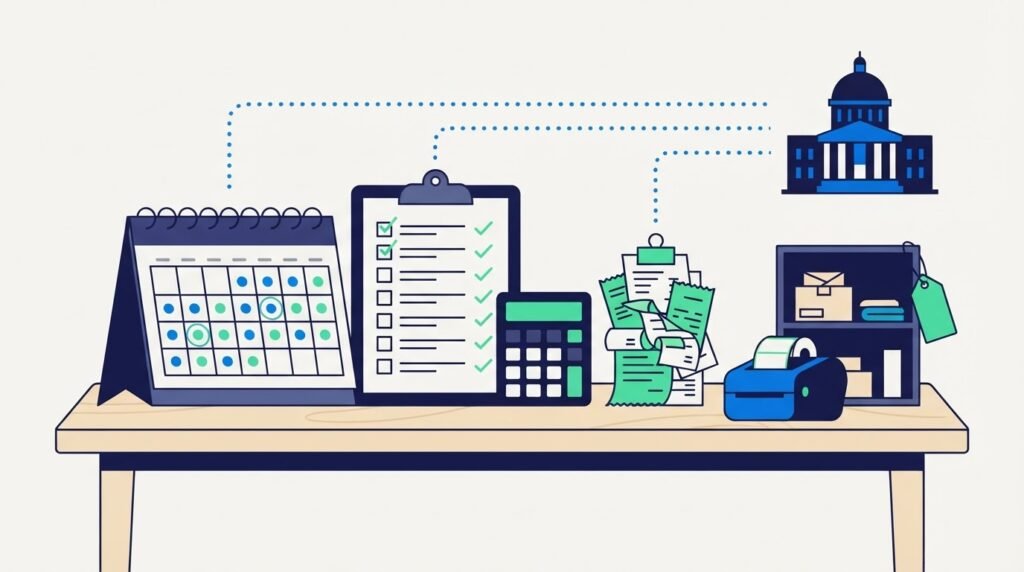
- January 1: the date your equipment is counted for the TPP return, and the start of the Sunbiz annual report window.
- April 1: DR-405 tangible personal property return due to your county property appraiser.
- May 1: last day to file the LLC annual report without the $400 late fee.
- Every reporting period (if registered): sales tax returns are due on the 1st and late after the 20th of the month following the period. The Department assigns your frequency and reviews it yearly.
Common Mistakes Florida Amazon Sellers Make
- Reporting Amazon orders as taxable sales. When Amazon has certified it collects, those sales stay off your Florida return.
- Selling outside Amazon without registering. A Florida-based seller collects tax on direct sales from the first one.
- Skipping zero returns. The $50 minimum late penalty applies even when no tax is due.
- Never filing a TPP return. Missing April 1 means losing the $25,000 exemption for that year.
Tips for Florida FBA Sellers
- List equipment purchases as you go with date and cost; that list becomes your DR-405.
- Plan for hurricane season if you prep inventory at home: keep stock off the floor and have a backup carrier pickup or drop-off point.
- Compare states before you expand. Our California Amazon business guide shows how differently another big state treats the same setup.
- Get help where it saves time. Our team offers Amazon, Walmart and Shopify store management for sellers who want to focus on products rather than admin.
FAQ
Does Amazon collect Florida sales tax for FBA sellers?
Yes. Amazon collects and remits Florida sales tax and county surtax on taxable orders placed through Amazon, and certifies that to sellers. You exclude those sales from your own Florida return.
Do I need a Florida sales tax registration to sell on Amazon?
A Florida-based seller must register and collect on any taxable sales made outside Amazon. If you sell only on Amazon, confirm your status with the Department of Revenue; many sellers register anyway to get the Annual Resale Certificate.
Is my FBA inventory subject to Florida tangible personal property tax?
No. Inventory held for sale is excluded from TPP. Business equipment such as computers, printers and shelving is reportable on Form DR-405 by April 1.
How much does it cost to start Amazon FBA in Florida?
State costs can be as low as $125 for an LLC, or nothing as a sole proprietor, plus a local business tax receipt. Amazon charges $39.99 a month on Professional or $0.99 per item on Individual, plus referral and FBA fees. Inventory is usually the biggest cost.
When is the Florida LLC annual report due?
Between January 1 and May 1 each year, starting the year after your LLC’s filing or effective date. The fee is $138.75, and a $400 late fee applies after May 1.
Conclusion
Amazon FBA in Florida works best when you are clear on the split: Amazon handles sales tax on its own orders and the logistics, while you handle your entity, any sales outside Amazon, resale certificate and use tax, and the county TPP return. Put January 1, April 1 and May 1 on your calendar, keep your Amazon tax reports, and you will avoid the penalties that catch most new Florida sellers. For more seller guides, visit the Msharf blog.
Looking to build or scale your Amazon, Walmart, or Shopify business? Msharf can help you develop and manage your e-commerce business. Book a consultation with our team.
Information in this guide is based on official sources (the Florida Division of Corporations, the Florida Department of Revenue, the IRS and Amazon) as of November 2026 and can change. It is general information, not legal or tax advice.